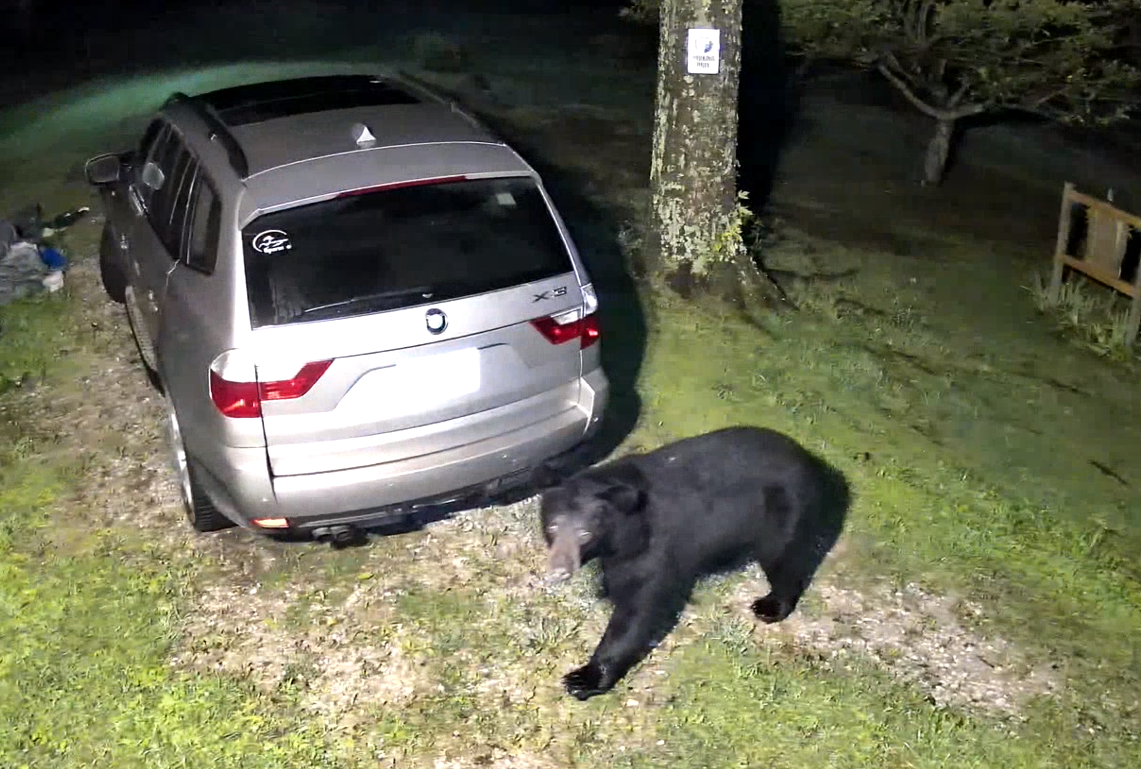
Last week, I promised you beers, bears, ollamas and tokens.
Apparently, I undersold it.
Because before we’re finished, we’re also going to need an elk, a pissed-off dog named Allie, Tom Petty, some artificial intelligence, a few unknown vehicles and approximately a decade of security-camera technology.
Let’s start with the elk.
Allie v. Elk
Let’s go back about nine years.
The video quality is fucking horrible.
And before somebody asks what kind of bargain-bin camera I bought — I’m sorry, but that’s about the best you could reasonably expect on a sensible budget back then. This wasn’t some $19 camera I found next to the extension cords at a flea market. For ordinary people who weren’t protecting Fort Knox, this was pretty much the state of the art.
The night vision was less “identify the suspect” and more “we can confirm that something with mass passed through eastern Kentucky sometime after dark.”
But here’s the important part: the picture quality wasn’t even the biggest limitation.
Something moved.
The camera recorded it.
Hell, you could train a monkey to do that.
And with a little more training, you might even teach the monkey to come find you afterward:
“Hey, boss. Something moved.”
Which reminds me — does anybody have a monkey for sale? I may have a position opening up.
The old camera didn’t know it was an elk.
It didn’t know Allie was a dog.
It damn sure didn’t know Allie had apparently decided that several hundred pounds of elk had violated some provision of the Buzz Mountain property code and needed to be escorted from the premises.
Allie sure knew, though, and demonstrated her guard duties superbly.
However, the camera system then knew only one thing:
Something moved.
So it recorded.
And we supplied all the intelligence afterward: manually finding the video because I was aware of the time, extracting that video and making use of it.
From Allie v. Elk to Bear v. Tom Petty
Now fast-forward about nine years.
Holy shit.
You don’t need me to explain the difference in video quality. You have eyes.
(Although we’re often told today not to believe what our eyes see and trust only what our leaders tell us — I digress.)
Today’s cameras can give us high-definition video, vastly better night vision, better frame rates, better dynamic range and enough detail that we’re no longer trying to determine whether that thing beside the driveway is a bear, a garbage can, or one of my friends staggering outside for a late-night smoke.
But the biggest improvement isn’t what we can see.
It’s what the camera can see.
That old camera saw pixels change and yelled:
“MOTION!”
Today’s cameras can look at the same scene and say:
That’s a person.
That’s a vehicle.
That’s an animal.
And, increasingly, with the right thought mechanisms applied, they can get even more specific.
That’s a bear.
That’s a hell of an improvement.
And if you’ve bought a security camera lately, you’ve probably seen AI DETECTION plastered somewhere on the box, the website or the app.
Sounds impressive.
But what exactly does that mean?
Usually, it means the manufacturer has taught its camera or its software to do a better job of deciding what caused the motion. Instead of telling you something moved, it might tell you a person moved or a vehicle moved.
That’s useful. It’s a huge improvement over our monkey.
But anybody who has lived with a bunch of these cameras knows it still isn’t perfect.
A shadow becomes a person. A bug becomes an animal. A tree moves just right and suddenly your phone thinks somebody is standing in the yard.
And every camera manufacturer has its own idea of what counts as important, how sensitive detection should be and when your phone ought to start dinging.
So I started asking a different question:
Why do I have to take the camera manufacturer’s word for it?
I don’t.
I can add another detection layer.
Instead of simply accepting every motion or “AI” event the camera hands me, I can analyze the actual video stream myself. I can look for the objects I care about, establish confidence thresholds, define the portions of a scene that actually matter and filter out a hell of a lot of the garbage before it ever deserves my attention.
The tree can keep waving.
The spider can keep building his web.
And that moth can keep thinking he’s one of those big-ass flying dinosaurs.
I don’t necessarily need to know about it.
Then I realized something else.
Why should any of this depend on the name stamped on the front of the camera?
I’ve accumulated different cameras for different jobs over the years. One brand might make a great camera for one location while somebody else’s works better somewhere else. And I’m sure as hell not throwing away a perfectly good camera just because I’ve decided to buy a different brand next time.
So I stopped thinking in terms of camera brands and started thinking in terms of capabilities.
If a camera can give me the video stream and capabilities I need, I can potentially use it.
The cameras become sensors.
My system supplies the intelligence.
And that lets me go another step.
If I’ve got a good enough image of a face, I can incorporate facial recognition and ask a much more useful question than Is that a person?
Which person is it?
Because there’s a pretty substantial difference between a burglar sneaking around Buzz Mountain at two in the morning and Cuz Dakota pulling in the driveway because he needs a little chronic.
One needs an alarm.
The other probably needs a lighter.
And since I’m apparently building a system capable of recognizing everybody who wanders around this mountain, here’s your fair warning and official Buzz Mountain public-service announcement:
If you’ve been up here, there’s a pretty good chance I’ve got your face.
So, shout-out to all of you who have unknowingly contributed to research and development over the years.
Your service is appreciated.
And there’s another reason I’m telling you all of this publicly.
Deterrence.
A security system doesn’t have to catch somebody to be useful. Sometimes its best day is the day somebody decides this particular place isn’t worth fucking with.
So if you’ve made it this far into the blog while contemplating some late-night unauthorized shopping on Buzz Mountain, let me save us both some trouble.
The cameras don’t just record motion.
My system alerts me daily to anyone on this mountain who doesn’t have a current face or vehicle association.
In other words, I’m not relying on myself to remember every face, every truck or every visitor who showed up in a day’s worth of video — because I can’t remember shit. (makes me Indictment proof.)
The system can help separate the people and vehicles it already knows from the ones it doesn’t.
That doesn’t mean an unfamiliar face is doing anything wrong. People buy new vehicles. Somebody brings a friend. Workhands show up.
Unknown doesn’t mean threat.
It means worth a look.
And here’s the part that’s probably more important to me than any of the technology I’ve described so far:
I don’t have to go back and watch the damn videos.
Ain’t nobody got time for that.
I’ve got cameras scattered around a mountain recording video 24 hours a day. I could spend hours every week clicking through recordings just to discover that absolutely nothing interesting happened.
I’m not doing it.
And I shouldn’t have to.
The whole point of adding intelligence to the system is to flip that relationship around.
I don’t go looking through the cameras trying to figure out what happened.
The system tells me what happened — and, more importantly, what I might actually give a shit about.
If everything looks normal, great. I don’t need a 47-minute highlight reel of people and vehicles I already know doing things they’re supposed to be doing.
But give me a face the system doesn’t recognize.
Give me a vehicle that doesn’t have a current association.
Give me a person inside a building that’s supposed to be empty.
Give me a door opening, followed by interior motion, followed by a person detection when the property is armed Away.
Now you’ve got my attention.
But Does the Property Know What’s Happening?
And that’s where I ran headfirst into the next problem.
A camera can tell me there’s a person.
My own detection can agree that, yes, that’s definitely a person.
Facial recognition might even tell me which person.
But none of those things, by themselves, tell me whether anything is wrong.
Think about it.
Somebody walking through my house in the middle of the afternoon while I’m home?
Probably not terribly interesting.
That same person walking through my house at 3:17 in the morning while I’m 300 miles away and the place is armed?
Now we’re having a different fucking conversation.
So I started looking beyond the cameras.
What does the rest of the property know?
Did a door just open?
Did a window open?
Was motion detected inside?
Did another camera see the same person?
Was that person seen getting out of a vehicle the system already knows?
Is the alarm armed?
Am I home?
Is anybody supposed to be there?
What happened immediately before this?
And what happened immediately afterward?
Individually, most of those things don’t mean much.
A door opening isn’t a burglary.
Motion in a room isn’t a burglary.
A camera seeing a person isn’t a burglary.
Even an unknown face isn’t a burglary.
But start putting those pieces together and something changes.
Evidence starts becoming context.
And context matters because we’ve all been trained by our own security systems to ignore them.
You know exactly what I’m talking about.
DING. Motion detected.
You pull out your phone.
Nothing.
DING. Person detected.
You look again.
That’s a fucking shrub.
DING. Motion detected.
Spider.
DING.
Leaves.
DING.
The same damn leaves.
Eventually, you quit looking.
That’s not because you’re irresponsible. It’s because your security system has spent months training you that most of its alerts aren’t worth your time.
And that’s completely fucking backwards.
I want a system I train.
Actually, scratch that.
I don’t want to train the damn thing either. Ain’t got time for that shit.
I want the system I’ve built to train it.
Let the system learn what’s normal around here. Let it build associations between the faces it sees, the vehicles they arrive in, the doors they use, the places they normally go and the times those things normally happen.
Let it use all the information already available across the property to get smarter about what deserves my attention.
And when it encounters something it can’t confidently explain?
Then ask me.
That’s where I belong in the process.
Not watching hours of recorded video.
Not dismissing 50 bullshit notifications.
Not teaching a camera that the same damn tree blowing in the same damn wind still isn’t a burglar.
Call me when you need a human.
I want the system to deal with the 49 things that don’t matter and make damn sure I pay attention to number 50 when it does.
Because the danger isn’t the false alert.
The danger is what all those false alerts teach you to do when the real one finally arrives.
Ignore it.
Instead of treating every sensor like a little electronic tattletale screaming for my attention, I can let the system compare what they’re all saying.
Interior motion by itself?
Interesting, maybe.
Interior motion shortly after an exterior door opened?
More interesting.
A person detected inside?
Now I’m paying attention.
A person detected inside, immediately after a door opened, while the property is armed Away and nobody is supposed to be there?
Okay. Now wake my ass up.
That’s where I think the next real leap in property security is going to happen.
Not another camera with two more megapixels.
Not another app sending another notification.
Not another fucking DING because a leaf moved.
Context.
I don’t need every device on the mountain competing to tell me what it saw.
I need the property to put the pieces together and tell me what happened.
And then tell me whether I need to give a shit.
Security Is Only Part of It
And then something else occurred to me.
I’ve spent all this time talking about security, but none of what I’ve built really has to be limited to security.
The system doesn’t actually care whether the information it’s putting together involves a burglar, a bear, a light switch or me.
And I’m not exactly a spring chicken.
Remember earlier when I said I can’t remember shit?
That wasn’t entirely a joke.
I failed that fucking cognitive test Trump is always bragging about acing.
So, yeah, I’ve got reason to think about this stuff.
And not just because of me.
My dad’s sister was a schoolteacher. She retired at around 54 years old.
Just a few years later, Alzheimer’s took her.
I’ve seen firsthand how quickly somebody can go from working, independent and living their life to needing help they never imagined they’d need.
So when I joke about someday forgetting how to operate a light switch, there’s some truth underneath the joke.
I don’t know what getting older has in store for me.
But I damn sure know I want to stay right here on Buzz Mountain for as long as I possibly can.
And that made me look at everything I’ve been building from a completely different direction.
What if the same intelligence I’m using to figure out whether somebody belongs in my house could also help me keep living in it?
Right now, if I walk into a dark room, I know how to operate a light switch.
Most days.
But what about ten or fifteen years from now?
What if someday I forget?
Or what if I remember perfectly well what a light switch does, but getting up and walking across a dark room to find the damn thing isn’t as easy as it used to be?
I don’t necessarily need somebody watching me.
I need the property watching out for me.
That’s a very different thing.
The same system that can learn that a person walking through my house at 3:17 in the morning while I’m 300 miles away is unusual can also learn that me walking through my own house at 3:17 in the morning is perfectly normal.
Turn on enough light for me to see where the hell I’m going.
Don’t make me ask.
Don’t make me find my phone.
Don’t make me remember some magic phrase I’m supposed to say.
And don’t make me learn a new damn app when I’m 80.
The house already knows it’s me.
It knows where I am.
It knows it’s dark.
It knows what normally happens next.
So why the hell am I operating the light switch?
And lighting is the easy example.
If the system learns what’s normal, then someday it can also recognize when normal changes.
Maybe I usually get up by a certain time and one morning I don’t.
Maybe I’ve been in one room much longer than I normally am.
Maybe I got out of bed in the middle of the night but never made it to the kitchen.
Maybe a door that I normally use hasn’t opened all day.
None of those things automatically means something is wrong.
Remember:
Evidence becomes context.
The same principle applies here.
And if enough little things don’t add up?
Call me when you need a human takes on a whole different meaning.
Maybe someday the human it calls isn’t me.
Maybe it’s somebody I’ve chosen — family, a friend, a caregiver — because the system has enough evidence to say:
Something about Kevin’s normal routine isn’t normal today. You might want to check on him.
Not a camera somebody is sitting around watching.
Not a microphone sending my life off somewhere for somebody else to listen to.
Not some damn button hanging around my neck waiting for me to realize I’m in trouble and remember to push it.
A property that has learned how I live and can quietly help me keep living that way.
That’s aging in place with some actual intelligence behind it.
And if I eventually forget how to operate a light switch?
Fine.
The house hasn’t.
And About Those Beers, Ollamas and Tokens…
If you read last week’s post, I promised you beers, bears, ollamas and tokens.
The bear you’ve met.
The beer?
BYOB.
This is Buzz Mountain, not a damn brewery.
There has, however, been drinking.
Research requires sacrifice.
As for the ollamas and tokens, they’re here too — just mostly behind the curtain.
They’re part of how I’m taking things like that bear recording, camera detections, faces, vehicles and all the other information flying around this mountain and turning it into something more useful than another DING on my phone.
I’m not going down that rabbit hole today. This post is already long enough, and explaining ollamas and tokens properly would require another beer.
Probably several.
We’ll get into the guts of how all this works in a future post.
For now, just know that I didn’t forget what I promised last week.
Beers. Bears. Ollamas. Tokens.
Delivered.
I just forgot to warn you about Allie v. Elk.
One More Thing
Somewhere along the way, I realized I wasn’t just screwing around with security cameras anymore.
I wasn’t even building a better security-camera system.
I was building something that could understand a property.
The cameras are part of it.
So are the doors.
The windows.
The motion sensors.
The alarm.
Faces.
Vehicles.
Time.
Location.
Whether I’m home or 300 miles away.
And, eventually, the people who live there.
Not spying on them.
Understanding enough about how they live to make the property work for them instead of making them work the property.
And all the other little pieces of information that don’t mean much by themselves but can mean a hell of a lot when something is smart enough to put them together.
Buzz Mountain has become the perfect place to build it.
I’ve got a house, a cabin, a BARn, a pavilion, cameras scattered all over the place, different networks, different buildings, different equipment from different manufacturers and enough weird shit wandering through here to keep testing interesting.
Hell, in one blog post alone we’ve managed to test the concept against an elk, a dog, a bear, friends looking for a late-night smoke, unknown vehicles, spiders, leaves and a moth that apparently thinks he’s some kind of big-ass flying dinosaur.
And I’m just getting started.
The more I’ve built, the more obvious it’s become that this doesn’t have to stop at Buzz Mountain.
So it isn’t going to.
That’s why I’m forming BuzzGrown Intelligence.
Buzz Mountain is where I’m building it.
Where I’m breaking it.
Where I’m teaching the system how to learn.
And where I’m finding out just how smart a property can become when all the pieces finally start talking to each other.
There will be a hell of a lot more to come on that.
But for now, if you’re wondering what any of this has to do with a nine-year-old video of Allie chasing an elk or a bear wandering through Buzz Mountain to Tom Petty…
Everything.
Ten years ago, my camera could tell me:
Something moved.
Today, it can tell me:
That’s a bear.
What I’m building next should be able to tell me:
That’s a bear. Everything’s fine. Go back to your beer.
Next Week on Buzz Blog…
Family. Traditions. And Pressie.
Some stories are too important to rush.
Next week, I’ll tell you hers.


Leave a Reply
You must be logged in to post a comment.